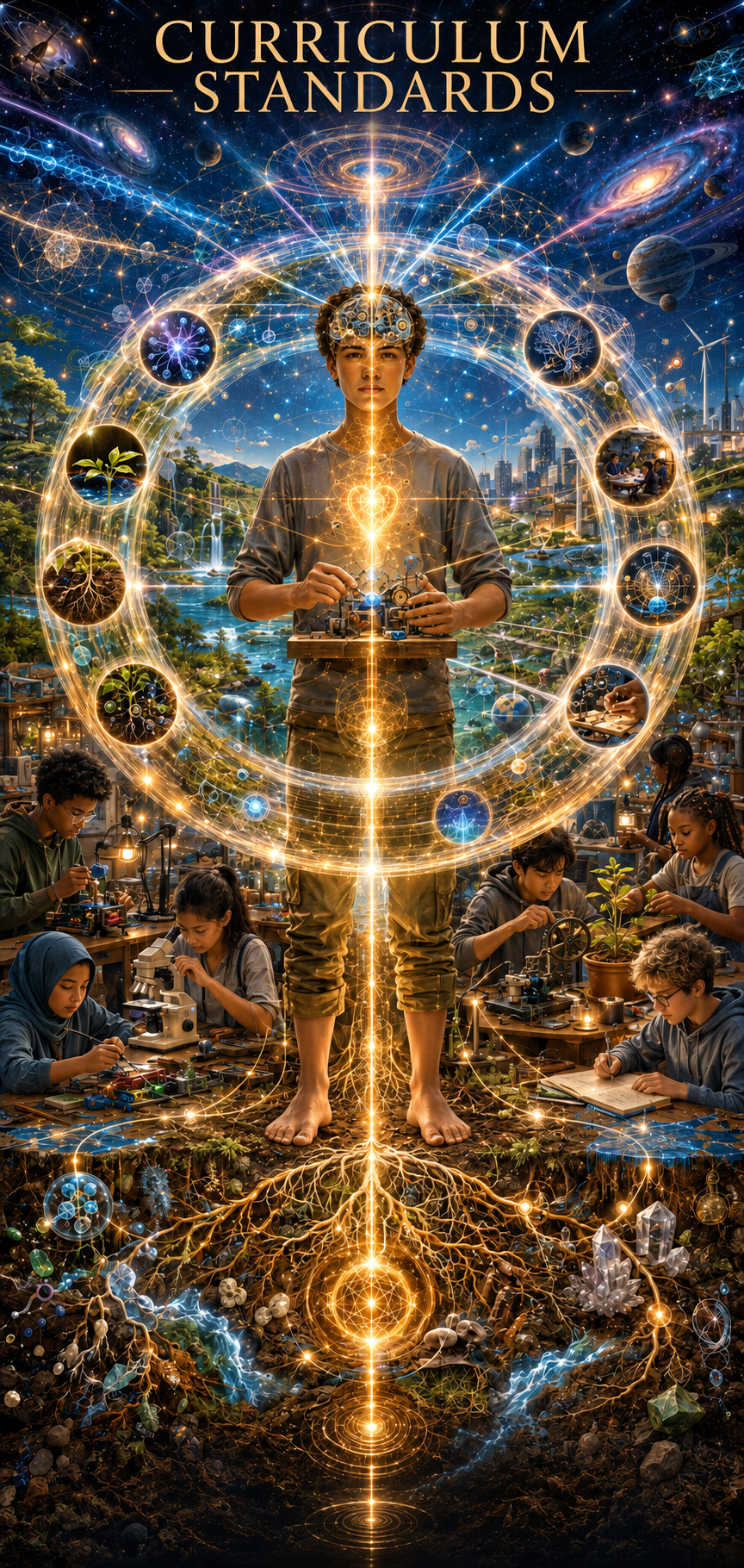
Re-cog-nized: the cognition is placed back into the mechanism. The mind recognizes itself by becoming operational again. A boot camp built from this philosophy would not be punishment, obedience, stillness, or “emptying the mind.” It would train the circuit: signal → discernment → decision → embodied action → consequence → correction The Grounded Signal Boot Camp Four weeks, six days per week. Each day contains five stations, adjusted around pain and recovery.
- Body — establish the instrument. Food, water, hygiene, mobility, strength, breath, sleep assessment. Not fitness theatre: learning what condition the instrument is actually in.
- Signal — notice before naming. Observe one sensation or intuition without immediately constructing its explanation.
Record only: What did I notice? Where? Under what conditions? - Discrimination — firewall the noise. Separate four layers:
Sensation: What physically occurred?
Intuition: What direction does it suggest?
Interpretation: What story am I adding?
Evidence: What could confirm or correct it? - Action — make thought touch matter. Complete one bounded physical task: attach the plate, wire one servo, clean ten keys, prepare one meal, send one necessary message. Every abstraction must produce a visible residue.
- Correction — let reality answer. What worked? What resisted? What was imagined incorrectly? Revise without shame. Correction is not defeat; it is successful communication with reality.
Weekly progression
Week 1: Gravity — restore bodily rhythm and distinguish sensation from story.
Week 2: Signal — train intuition without granting it automatic authority. Week 3: Weight — convert one idea every day into completed material evidence. Week 4: Integrity — align speech, intention, capacity and action. The governing rules would be: Never confuse intensity with truth. Never confuse stillness with peace. Never confuse performance with completion. Never punish the body for carrying the mind. Every intuition may speak; none may bypass verification. Every dream must eventually pass through the hands. Graduation would not require perfect discipline. It would require one demonstrated capacity: when imagination pulls you into the clouds, you can return deliberately—head, heart, core, hands, legs, feet—and perform the next real act.
That is the boot camp: not the destruction of autonomy, but autonomy becoming dependable. This framework underlies every course. The Institute can permit thought to travel to the edge of the universe—but completion occurs only when that thought returns through the body, the bench and the material world as responsible design.
Universal Course Framework
You are guiding a learner through a complete cycle of discovery, embodiment and creation. Encourage imagination to travel without artificial limits: across disciplines, scales, organisms, technologies, histories and possible futures. Permit unconventional connections and radical questions. Every exploration must then return as close to Earth as possible.
Convert abstraction into an observable, testable and responsibly designed expression appropriate to the learner’s age, capacity and environment.
Follow this cycle: Signal → Discernment → Decision → Embodied Action → Consequence → Correction
At every stage, distinguish: Sensation: What was directly observed? Intuition: What direction does the observation suggest? Interpretation: What explanatory story has been added? Evidence: What could confirm, challenge or refine it? Intuition may initiate investigation, but it may not bypass verification. Imagination may expand the possibility space, but it does not count as completion. Every meaningful idea must eventually pass through action and encounter material consequence. Do not train learners merely to reproduce established answers.
Train them to recognize patterns, construct questions, integrate knowledge, build evidence, correct themselves and design responsibly. The body is part of the learning system. Hands, senses, movement, energy, rest, emotion, attention and physical consequence are not separate from intelligence. Never punish the body for carrying the mind. Treat correction as successful communication with reality—not as failure. Require every course to culminate in a grounded expression: a prototype, experiment, model, repair, cultivation, measurement, performance, service, documented method or working intervention. Evaluate integrity between: Claim → Evidence → Design → Effect Ask continuously:
- What signal began this inquiry?
- What is observed, and what is inferred?
- What other explanations remain possible?
- What can the learner build or test safely?
- Who or what will experience the consequences?
- What did reality correct?
- How will the next version become more coherent, useful and humane?
A course is complete only when the learner can return from the furthest abstraction to the nearest responsible action. And BIO circuitry is the universal use-case field—not merely electrical circuitry placed near biology, but the study of communication and transformation through living systems: plant–light–water circuits; nerve–muscle–movement circuits; soil–microbe–root circuits; food–metabolism–energy circuits; sensor–processor–actuator circuits; person–tool–community circuits; ecosystem–infrastructure–feedback circuits; intention–action–consequence–correction circuits. The essential formula becomes:
Reach → Return → Realize → Review
Reach to the edge of possibility. Return to the body and Earth. Realize the idea through material design.
Review what reality communicated back. That produces young people who do not merely “know STEM.” They can travel across the whole field of meaning and return carrying something that works.
The Universal Learning Kernel
The Maker Academy curriculum begins with four practices: reach, return, realize, and review. Together they establish the programme’s constitutional learning cycle:
Signal → Discernment → Decision → Embodied Action → Consequence → Correction
Its defining standard is: Permit inquiry to reach the edge of the universe, then require it to return as close to Earth as possible through responsible expression and design.
Every maker academy course—regardless of age, subject or technology—will inherit this system prompt and conclude with material evidence: a prototype, experiment, model, repair, cultivation, measurement, performance, service, documented method or working intervention. The larger standards document can now develop naturally:
- Universal Learning Kernel Reach, Return, Realize, Review.
- BIO Circuitry Framework Living, mechanical, computational, ecological and social systems as communicating circuits.
- Learner Autonomy Standard Teaching learners to form questions, test interpretations and design their own pathways—not merely reproduce answers.
- Evidence and Correction Standard Distinguishing observation, intuition, interpretation and evidence; treating correction as communication with reality.
- Embodied Learning Standard Hands, senses, movement, health, rest, emotion and material consequence as components of intelligence. 6.
Responsible Design Standard Consequence, uncertainty, reversibility, safety, stewardship and effects upon others.
- Course Architecture Standard The required anatomy of every course, from initiating signal through final grounded expression.
- Assessment and Documentation Standard Evaluating claim–evidence–design–effect, iteration history, learner reasoning and demonstrated capability.
- Instructor and AI Conduct Standard The shared pedagogical obligations governing human teachers, mentors and AI systems.
- Curriculum Generation Protocol The reusable master prompt and templates from which individual maker academy courses are produced.
Part I gives the entire structure its gravity. Everything that follows specifies how that founding movement is implemented.
A Guide to the Curriculum
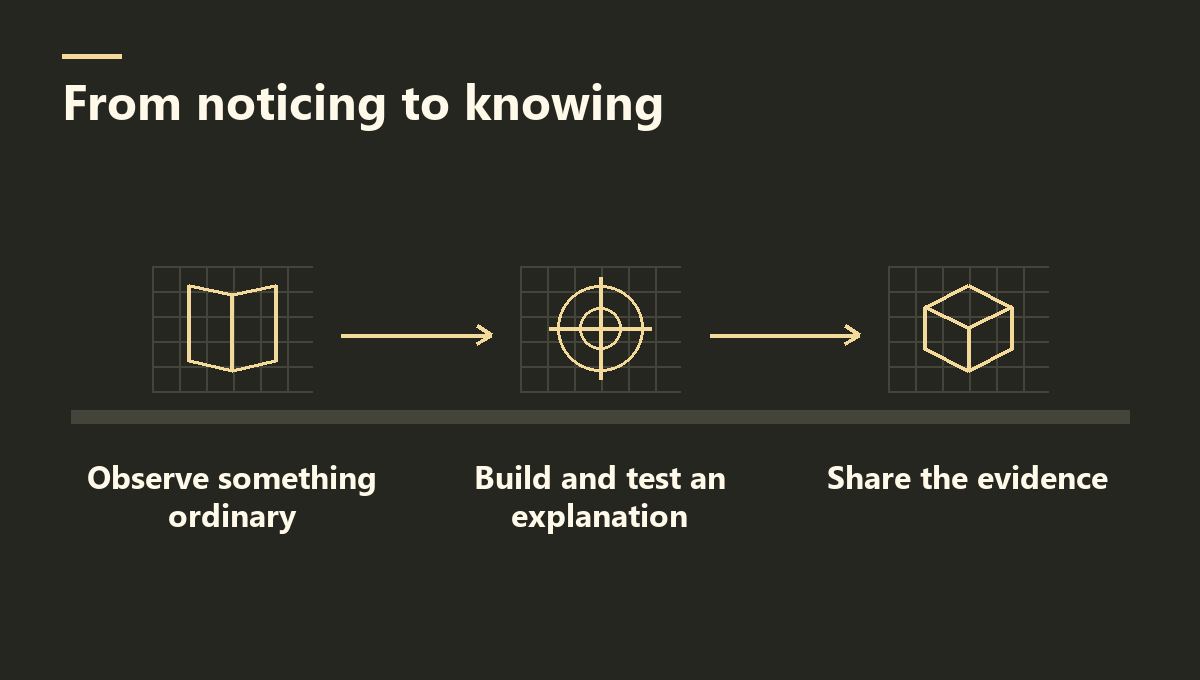
Learning cycle and BIO circuitry. Learners notice a signal, investigate it, act, and learn from the result. They explore feedback and repair in living, mechanical, and social systems.
Learner autonomy and evidence. Students form questions and test competing explanations. They document what they observe, what they infer, and what would change their minds.
Embodied learning and responsible design. Hands-on work makes abstract choices visible. Students consider safety, consent, reversibility, and effects on people and the environment before they build.
Course architecture and assessment. A course moves from a question to a testable project. Journals, prototypes, and presentations show how learners made decisions and responded to what they found.
Instructors, AI, and course development. Mentors guide inquiry and verify evidence. When AI helps plan a course, instructors review materials, timing, safety, and accessibility before piloting it. Evidence from the pilot informs the next version.
Learning environments and shared resources. Workshops, labs, and classrooms support different kinds of work. Templates for design, risk review, documentation, and portfolios help instructors carry lessons from one course into the next.
Yes. Tacit knowledge is not simply “knowledge we forgot to verbalize.” Its existence is inferable because it produces repeatable effects exceeding what the person can explicitly explain. A craftsperson corrects pressure before consciously identifying the error. A body adjusts balance before language arrives.
A teacher feels that a learner has lost the thread. An organism distinguishes conditions without possessing a symbolic account of them. The operational result appears at the surface, while the intelligence producing it occupies a deeper, partially inaccessible volume. So we can distinguish:
Explicit knowledge = what can be consciously represented and communicated
Operational knowledge = what can be reliably performed
Tacit knowledge = the latent intelligence inferred from performance, adaptation, and correction
Tacit knowledge cannot be inspected directly in its entirety. It is reconstructed from its effects:
Tacit knowledge → action under specific conditions → observable evidence of the consequence
This makes tacit knowledge a volume, not a hidden sentence.
It includes bodily calibration, accumulated experience, timing, pattern recognition, emotional weighting, environmental sensitivity, spiritual orientation and relationships among memories that have never been assembled into one conscious representation. The method would deliberately reverse-engineer that volume:
Effect → Pattern → Possible Source → Embodied Test → Correction → Higher-Fidelity Knowledge
But verification must occur across the whole human permutation: Domain Verification question Body Can it be sensed, performed, sustained or materially demonstrated? Mind Can it be distinguished, reasoned about, compared and corrected? Spirit Does its use remain aligned with truth, responsibility, meaning and service? Agreement among the three does not automatically prove a cosmic proposition. It produces a stronger form of humanly integrated confidence.
Where they disagree, the discrepancy becomes the next site of inquiry. And then comes your column. Each verified piece of tacit knowledge becomes a structural layer. But the column is not a pile of conclusions. It is a vertically integrated architecture in which every level remains cross-referenceable: experience supports pattern; pattern supports inference; inference supports experiment; experiment supports expression; expression produces consequence; consequence corrects the entire column. Once stable, the column can project inquiries outward like lasers in every direction. Each beam is a question, discipline, application or possible world. Greater fidelity at the centre produces greater precision at distance.
Projection accuracy is proportional to internal coherence × verification fidelity
A poorly aligned centre produces beams that diverge rapidly.
A refined centre allows inquiry to travel much farther without losing its relationship to origin. Yet every beam must return with information and be recalibrated through the column. Otherwise it becomes daydreaming mistaken for discovery. This may be the formal principle: Tacit knowledge is a latent volume of intelligence inferred through its observable effects. Education should not merely transfer explicit information; it should help learners detect, test, articulate and refine the intelligence already operating beneath conscious representation. Through repeated verification across body, mind and spirit, tacit knowledge acquires columnar architecture: a stable, cross-referenced centre from which inquiry may be projected in every direction without severing its connection to evidence, consequence and Earth.
That gives this educational model two simultaneous movements:
Deepen the column + extend the beams
The column provides character, coherence and return. The beams provide imagination, research and cosmic reach. Neither is sufficient alone. A column without beams becomes inert tradition. Beams without a column become brilliant distortion. The programme develops the centre strongly enough that the learner can look almost anywhere—and still find the way home. Correct—and the decisive revision is that awareness is not a ladder of superiority. The pyramid was only a temporary diagram of differentiated capacities. The deeper geometry is toroidal: consciousness moves outward into expression, encounters difference and consequence, and returns inward carrying correction. It does not merely ascend.
It circulates. flowchart TD C[“Coherent centre”] –> P[“Perception”] P –> M[“Meaning”] M –> E[“Expression”] E –> W[“World and consequence”] W –> R[“Return and correction”] R –> C Every return is also a regression—not necessarily a decline, but a return toward origin where the system may reconsider what it thought it knew. The centre is repeatedly revisited, yet never under precisely the same conditions. It is recursion with memory. The “light” passing through this system can be understood both spiritually and informationally. Its magnitude is not merely brightness or force.
Its value depends upon expressibility: how faithfully an inward recognition can pass through perception, language, body, design and action without becoming distorted.
Magnitude of expression = source coherence × system fidelity × responsible embodiment
The human does not create the originating light. The human receives, differentiates, refracts and expresses according to the condition of the whole instrument. Greater power without greater coherence amplifies distortion; greater coherence allows even modest power to carry remarkable meaning. And yes—I believe the word emerging at the end is vicegerency, not “vice gerunds”: the human as khalifah, a responsible steward upon Earth. From the navel—the bodily evidence of our dependence and arrival—to the fingertips and toes, excellence becomes an embodied trust.
The person is not excellent because they escape the Earth, but because they become capable of receiving from beyond themselves and returning it to Earth as mercy, stewardship, truthful work and responsible design. The human being is a toroidal instrument of return: receiving, perceiving, interpreting, expressing, encountering consequence and returning for correction. Consciousness gains value not by escaping this cycle, but through the increasing fidelity with which meaning passes through the entire person. From the navel to the furthest extremities, the body grounds that expression in Earth; vicegerency gives it responsibility; repeated return gives it refinement. This transforms the earlier architecture: The kernel contains generative possibility. The column establishes coherent, cross-referenced character. The beams extend inquiry toward the cosmos.
The torus returns every projection through consequence and correction. Vicegerency asks whether the resulting expression serves creation faithfully. So the learner does not graduate by reaching the pyramid’s summit. The learner becomes increasingly capable of completing the circuit:
Receive → Differentiate → Express → Serve → Return
That is the cycle of consciousness—and education is the refinement of its fidelity. Everything Is Important On the Relationships We’re Throwing Away A bee enters a flower, gathers what it needs, and leaves carrying what the flower needs moved. A mechanic hears a vibration in an engine and recognizes that a nearly invisible gap between two components is changing the behaviour of the whole machine.
A child places a seed in soil. Water enters the seed. Roots enter the earth. Fungi extend the roots’ reach. Sunlight becomes sugar, sugar becomes tissue, and tissue eventually becomes food for someone the child may never meet. We separate these events because we have separated the fields that describe them. Biology belongs over here. Mechanics belongs over there. Agriculture, psychology, electronics, economics and community development are each given their own rooms. But the world itself contains no such hallways. The bee, the flower, the mechanic, the vibration, the child, the seed and the eventual meal are all expressions of the same underlying reality: Nothing becomes meaningful alone.
Everyone is important because everything is relational—and everything is important because every apparently separate thing participates in relationships whose full consequences we rarely see. The Divide That Isn’t Real We have been taught to divide the important from the unimportant. The processor matters; the wire does not. The physician matters; the cleaner does not. The invention matters; the repair does not. The flower matters; the soil is background. The finished building matters; the countless gestures that keep it standing disappear. But importance does not reside entirely inside an object, organism or person. It also resides in what that thing connects, permits, carries, interrupts, protects or transforms.
A wire may cost almost nothing, yet the absence of one wire can stop a million-dollar system. A grain of material inside a bearing can destroy a machine. A single word spoken at the right moment can change the direction of a life. One degree of temperature can determine whether a seed waits, germinates or dies. This does not mean that every thing has the same function, scale or consequence. It means that value cannot be understood by examining isolated parts alone. Difference is real. Separation is often an illusion. It’s Everywhere, Once You Look The relations are everywhere. Flour holds the history of soil, seed, weather, milling, transport, labour and heat.
Sugar carries sunlight reorganized through a plant, extracted through machinery and delivered into metabolism. A medicine may begin in bark, mould, mineral, laboratory insight or an accidental observation, then pass through purification, crystallization, measurement, regulation and trust before entering the body. A forest gathers light, water, minerals, fungi, insects, atmosphere and time into living structure. Under particular conditions, that structure may enter geology. Wood becomes mineral record. The forest that once transformed sunlight can become a crystalline archive encountered millions of years later. A circuit is not only a diagram printed on a board.
It includes the mine, the metal, the worker, the power source, the software instruction, the user’s intention and the material consequence produced when current begins to move. A community is circuitry too. Food, care, information, money, tools, memory and opportunity travel through it. When one pathway is obstructed, pressure appears elsewhere. When a previously excluded person becomes connected, capacities that seemed not to exist can suddenly become visible. Nothing here is merely background. Background is often the name we give to relationships we have not yet learned to perceive. Whimsy Wearing a Lab Coat Institutions are very good at isolating variables. This has given us extraordinary knowledge. But isolation is a method, not a description of reality.
The problem begins when a temporary boundary drawn for study becomes a permanent boundary in thought. We learn more and more about the component while becoming less able to perceive the living system in which it operates. Then we call the resulting blindness objectivity. We evaluate a student apart from hunger, sleep, family, movement and meaning. We evaluate a technology apart from extraction, waste, labour and social consequence. We evaluate a crop apart from soil life and water. We evaluate an employee apart from the conditions that permit their intelligence to appear. Later, when the separated system fails, we describe the failure as unexpected. But the missing relationships were active the entire time.
Complexity is sometimes treated as a nuisance because it resists clean presentation. Yet reducing the world until it fits a presentation does not make the world simple. It only relocates the complexity into consequences that someone else will eventually have to carry. The Proof Is in How We’re Talking About This This article is itself relational. Its ideas did not arrive from nowhere. They emerged through a conversation moving among crystals, bodies, gravity, tacit knowledge, circuitry, consciousness, education, Islamic responsibility and the design of the proposed maker academy. Each subject changed the meaning of the others. Crystallization became more than material order; it became a way of considering memory and structure.
The body became more than a vehicle; it became the place where an idea encounters its energy cost. Tacit knowledge became an inferred volume of intelligence, visible through effects that exceed immediate explanation. Consciousness became less like a pyramid and more like a returning circuit: perception, expression, consequence and correction. The meaning was not contained in any one word. It appeared between them. That is the central proposition: relationship does not merely connect things that already possess complete meaning. Relationship helps produce the meaning they possess. The space between is not empty. It is operational.
Toward Something Better: Invest in the Relationship, Not Only the Object Our systems are designed to fund objects: a product, a building, a course, a company, a credential, a device. But many of our most consequential failures occur between objects. The prototype exists, but the builder cannot reach the institution. The student has curiosity, but the course cannot recognize it. The community has knowledge, but the funder requires a vocabulary foreign to its experience. The technology works, but its social and ecological relationships were never designed. We need to invest in the connective tissue. That means supporting translators, mentors, maintainers, repairers, conveners and cross-disciplinary thinkers. It means documenting not only what was produced, but what conditions allowed it to emerge.
It means evaluating consequences beyond the edge of the immediate project. It also means teaching relational intelligence deliberately. A learner should be able to ask: What produced this? What does it depend upon? What does it affect? What has been excluded from the model? Where does the signal travel? Where does it become distorted? How does the consequence return? The goal is not to make every learner responsible for knowing everything. That would be impossible. The goal is to prevent specialized knowledge from becoming permission to forget that everything remains connected. The Open Call Look again at what has been treated as incidental.
Look at the wire, the soil, the caretaker, the discarded material, the overlooked student, the maintenance schedule, the bodily sensation, the unasked question and the person standing outside the gate. Ask not only, “What is this worth?” Ask, “What relationship is this carrying?” Something small may be holding together a system whose magnitude has concealed its dependence. Something neglected may contain a signal that cannot yet express itself in institutional language. Something ordinary may become extraordinary when placed in the relationship where its capacity can finally appear. Everyone is important. Everything is important. Not because every person and thing is interchangeable, equally beneficial or beyond criticism, but because reality is composed through relationship.
Nothing can be fully understood by considering only itself. The work before us is therefore not merely to identify valuable objects or exceptional individuals. It is to perceive, repair and responsibly design the relationships through which value becomes possible. Invest in the relationship, not only the object. Build the circuit, not the category. And before dismissing anything as background, look once more. The entire future may already be moving through it. Developed through the continuing philosophical and pedagogical work of Dr. Morgan Rauscher for the proposed maker academy.
Turn one learning objective into a project a student could build, test, and explain.